David Yang and shuang cai
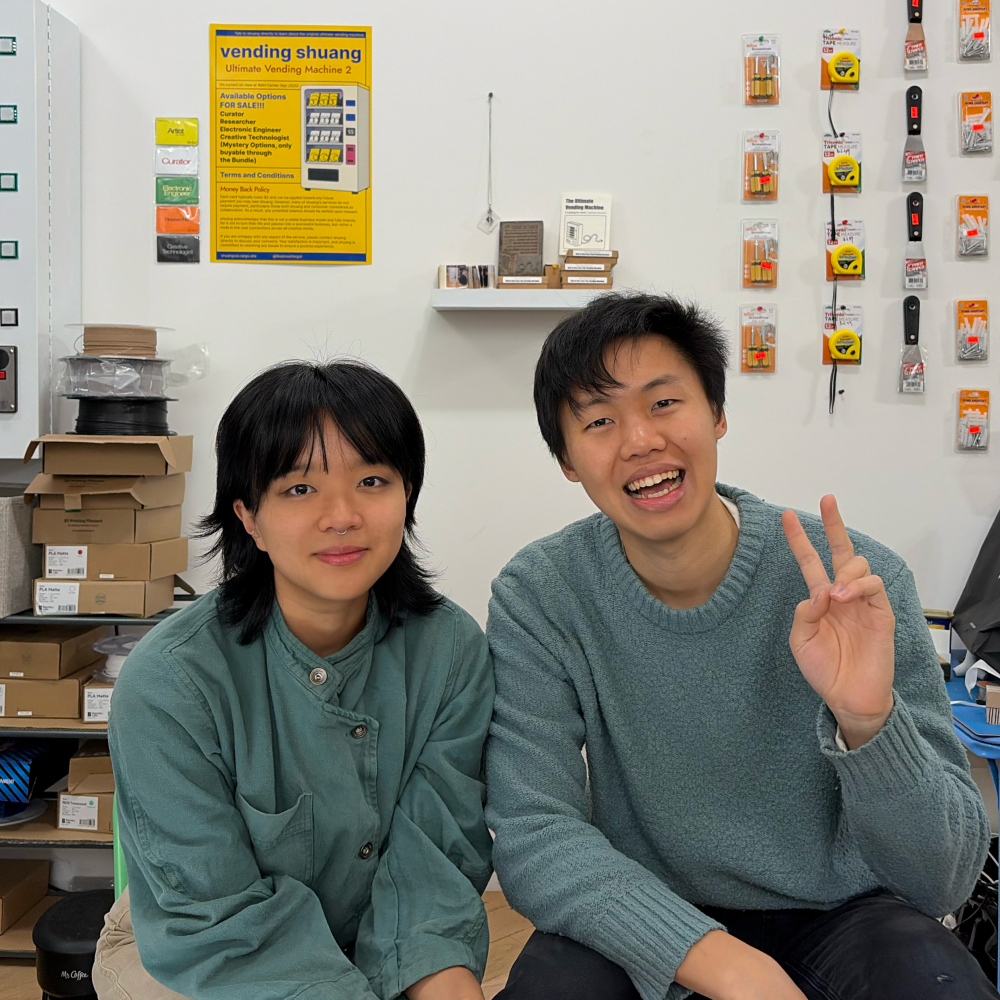
David Yang and shuang cai are both coders, designers and artists who attended NYU's ITP program. They are part of the Applied Experiment cohort of 2025.
This interview was conducted by Andrew Trousdale on behalf of APOSSIBLE.
Andrew
What is a ritual, practice, or routine in your life that is important for your psychological wellbeing and/or fulfillment? Why?
Both
For both of us, keeping a studio practice itself has been an on-going ritual that is important for each of us. Since graduating a few years ago, we’ve each been hustling outside of our art practice, juggling work and everyday logistics. Yet, keeping a studio practice, however irregular, grounds us.
Our ritual in practice doesn’t always look like a morning hour reserved for writing or the coffee making before starting a project. Our practice is managing Amazon returns, splitting profiles in Arc the browser, share 3 different google drive folders. On paper, this chaos seems far from healthy or meditative—but to us, the hecticness itself is part of the ritual. We see the patterns in the chaos: a recurring meeting on our calendar, a growing list of completed tasks on Notion, the steady rhythm of successful 3D print notifications. In the chaos we organize. Balancing what interests us with what sustains us forces us to stay attuned to the world and the people around us. This constant negotiation to create room for making keeps us grounded and connected.
David
A hot shower in cold weather has always been a routine where I can find myself. Perhaps it is the mist that takes me back to Yangmingshan, the mountain where I grew up, or the foggy glass that becomes a canvas for my thoughts, shaped and erased by droplets of water. Or maybe it is the memory of a hot spring, where the awareness of nature and the feeling of relaxation exist together. In those moments, I feel safe being who I am.
I feel most fulfilled when I work on projects with friends, bringing ideas to life for people I care about and making things to be shared with kindness. shuang is someone I care about, and it was the best feeling in the world when we shared our Mist Maker project at the Open Hardware Summit this year.
shuang
The practice that keeps me balanced is maintaining several forms of work at once — curating, art-making, engineering, and research. I’ve tried separating them before, but they always find their way back into each other – all tangled together and somewhat related to each other.
This year, I split my life between Ithaca and New York. The move was propelled by opportunities to expand my practice with flexibility and freedom. This physical life change helped me better balance and split, but the real work has been learning how to move between them without losing focus. Travel itself has become a ritual of recalibration. I use the bus rides or drives as moments to compress and expand ideas, to shift between the languages of each discipline, or organize thoughts and processes that either happened or about to happen.
As mentioned before, balancing these practices isn’t always peaceful, but for me it’s stabilizing. The friction between systems — the academic calendar, submission deadlines, exhibition install and openings – creates the rhythm for me. It reminds me how ritual does not come from repetition but from consistency: when every part of my work, however different, orbits the same curiosity about how people and systems interact.
Andrew
What is a human-made creation that brings out the best in you? Why?
Both
Maybe this is a trick answer for the question… For both of us, a good collaboration is a human-made creation that brings out the best in who we are. We see collaborations as an invisible structure that the collaborators built on personal connection and care. We’ve found this not only through making art with others, but also through making shows that includes a diverse body of people, writing that invites a response, and through making tools that spark exchange. In these collaborations, we both find clarity.
From our collaboration, David’s strength in patience and precision complements shuang’s tendency to build across disciplines. What holds our collaboration together is a sense of play and the openness that invites more collaborations in the future.
A good collaboration reminds us that making isn’t only about producing things for consumption; it’s about designs that allow people to meet each other again and again.
Andrew
When do you cherish the slow or hard way of doing something? Why?
David
I cherish every moment of slowness and the friction when I communicate with my grandma. It is difficult now that I live in a foreign country, working and speaking in a language different from hers. But every single second I spend with her, whether on a call or in person, listening to how her day went and sharing my own day, my work, and my friends with her, is worth it and deeply cherished.
shuang
In recent years, I’ve realized I have a tendency to think and make things about the process itself — to think about thinking and make about making. It’s a slow and sometimes exhausting way to move through work, because it means I’m often explaining, reframing, or analyzing the idea before everything else. However, this slowness fuels both creativity and connection. When ideas are taken apart, they become open — available for others to interpret, reshape, and respond to. The hard way allows space for uncertainty, and in that space, collaboration happens. It’s not about control or clarity, but about keeping the process alive long enough for something unexpected to appear between people.
- When the idea of slowness/hardness/glitch/misalign is part of the anchoring process of the creation
- When the slowness is because it is contributing to communities and therefore the iterative processes are dragged out
- When the hardness is not caused by systemic issue but a process that you can contribute to make better — hardness become your discovery and something you can create to change
Andrew
What is something you appreciate or long for from the past? Why?
David
I miss Blockbuster. The experience of walking down the street after dinner with my family to rent a movie, checking whether someone had returned their copy of Harry Potter and the Chamber of Secrets as a kid, still feels special to me. Those walks often came with small surprises: bumping into friends, sharing quick gossip with the doorman about neighbors, or saying hi to the tofu pudding shop auntie down the street, where we ended our walk before heading back home.
Blockbuster felt like an asynchronous conversation with people in my community, a place where our lives intersected in subtle ways. I think what I really miss is that feeling of neighborhood, tangible technology, and communal space intertwined in our lives.
shuang
I miss writing to people. Texting, calling, and video meetings are convenient/easy/fast connections (also enabling more). As much as I like texting the most random thoughts and memes to my friends, I miss having to put up the effort to formulate thoughts, making a memo, and being patient till there are enough to talk about. So many steps and pauses built tension—the stamp pressed onto the envelope, the walk to the mailbox, the wait for a reply. I’d like to believe that the action of writing letters made me think about people and my connection to them differently. I long for this not because I think it should replace all modern fast communication, but because I think variation and alternatives are important – especially when it comes to interpersonal relationships. Different speeds, different vantage points, allow relationships to unfold with more texture and allow me to understand and communicate better with other people.
This is part of our Interview Series. Join our newsletter to receive updates weekly by email.