Framework
This is our work-in-progress framework, based on positive psychology, helping to define the human flourishing we want technology to aspire to.
Our mission at APOSSIBLE is to empower technology that brings out the best in us.
Drawing from positive psychology, we believe that genuine human flourishing comes from exercising our strengths and virtues.
Many technologies make something easier, faster, or more comfortable. Despite these clear benefits, such tools can inadvertently go against our flourishing. For example, when all information is instantly available online, patience and curiosity are less necessary for learning about the world and when the GPS tells us exactly where to go, we may lose our sense of spontaneity and our willingness to ask others for help.
We’re not against technology. We’re focused on how it can empower the active use of strengths and virtues. Such tools may not be the easiest to use; they require effort and active engagement. But this is what's necessary for technology to support human flourishing. Put differently, human flourishing is not passive. It cannot be delivered to people by technology. The best it can do is empower a person to actively express their strengths.
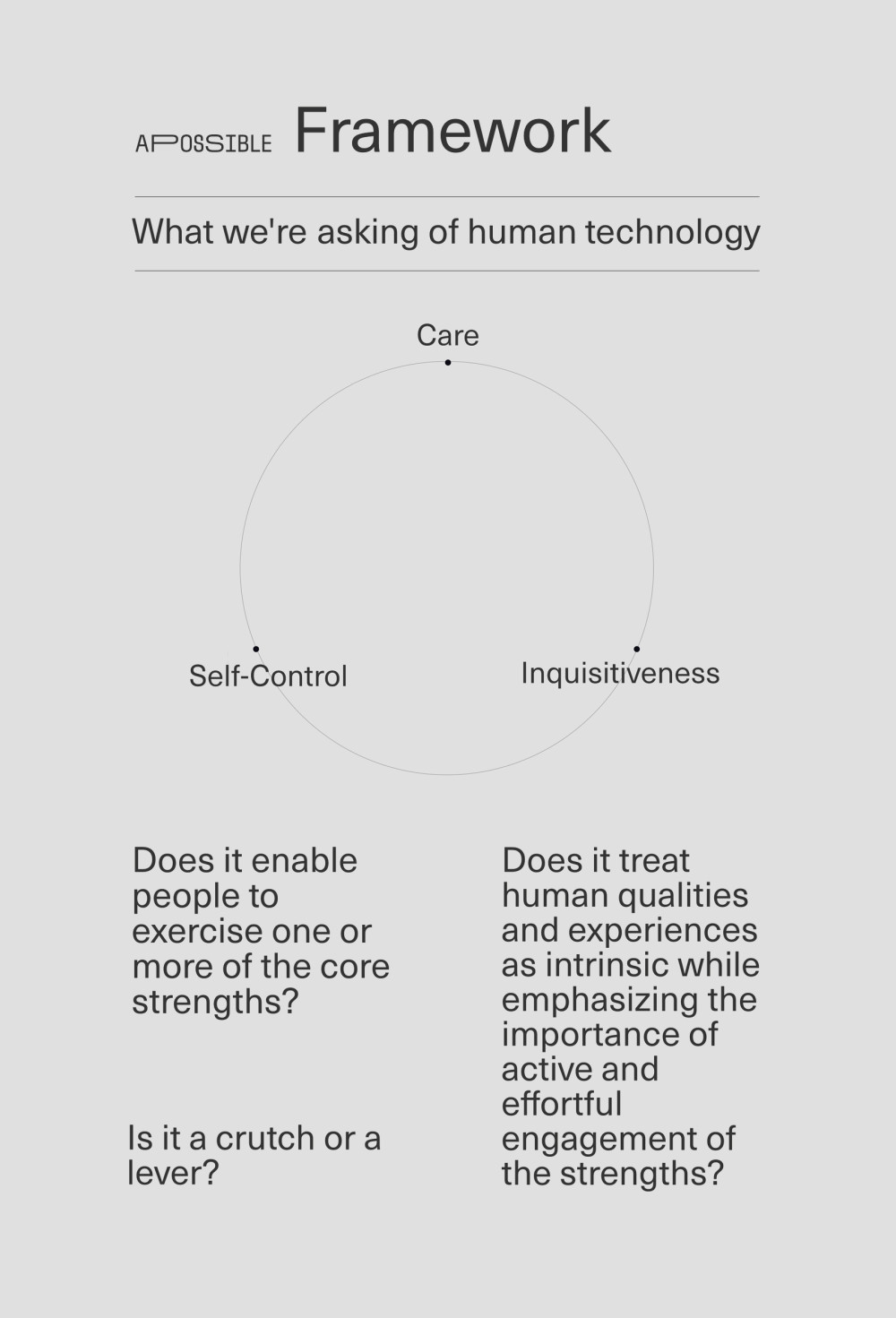
Care, Inquisitiveness and Self-Control
In the 2000s, a group of psychologists studied cultures worldwide and across time. They found that the human strengths we must exercise in order to flourish typically cluster into three key areas:
Heart
Strengths of care, or heart - dealing with connection, empathy, and compassion.
Mind
Strengths of inquisitiveness, or mind - dealing with creativity, curiosity, and learning.
Will
Strengths of self-control, or will - dealing with perseverance, courage, and determination.
This three-part framework shapes how we approach the possible psychological benefits of any given tool. The key question for human technology then becomes: what psychological strength or virtue does it empower?
Intrinsic and Active
The emphasis on strengths and virtues tells us where much technology falls short of fostering human flourishing:
- Tools of leisure and amusement may be designed for intrinsic reward but they displace the active use of strengths with passive consumption
- Tools of efficiency and productivity channel strengths and virtues but view them as instrumental toward extrinsic ends
What we call human technology borrows elements of both: it treats human qualities and experiences as intrinsic, but it emphasizes the importance of active and effortful engagement of the strengths.
Consider that a hammer can be used for the most demanding and repetitive jobs but also in the process of voluntary craftsmanship. Or consider that video games can be mindless and dissociative or they can involve skill, collaboration, and aesthetic expression.
Crutch vs. Lever
No technology is inherently good or bad—what matters is what you consider good, and how the particular way of using a technology promotes or compromises that.
We are interested in technologies that bring out human flourishing. And we follow positive psychology and humanistic philosophy, which say that human flourishing follows from exercising our strengths and virtues.
So, technologies promote human flourishing when they empower the strengths and virtues. And they undermine flourishing when they displace the strengths. It's the difference between a lever and a crutch:
Lever
Magnifies, invites, or stretches a capacity you already possess. It adds mechanical advantage while still asking you to do meaningful work. Strengths are engaged and strengthened → builds flourishing.
Crutch
Substitutes for (or dampens the need for) a capacity. It carries the load for you, so the underlying strength atrophies or never activates. Strengths are displaced or bypassed → erodes flourishing.